Please visit my flickr site to see more of Taiwan through my camera lens!
Wednesday, July 14, 2010
Yingge Ceramics Biennale Slide Show
The opening of the 2010 Taiwan Ceramics Biennale this weekend at the Yingge Ceramics Museum was chock-full of exciting events including huge mascot-like characters dancing to a techno version of traditional Taiwanese music. Huh? Yeah, there's a lot to share, but for now I will satisfy your interest visually with a little slideshow and coming soon will be more in-depth coverage of my experience from the behind-the-scenes set-up to the closing discussion of the coinciding symposium: "Is international ceramics competition dead but not yet lying down?" Mmmmmmm . . . . nourishment for your intellect!
Please visit my flickr site to see more of Taiwan through my camera lens!
Please visit my flickr site to see more of Taiwan through my camera lens!


Sunday, May 23, 2010
YODEX Taipei
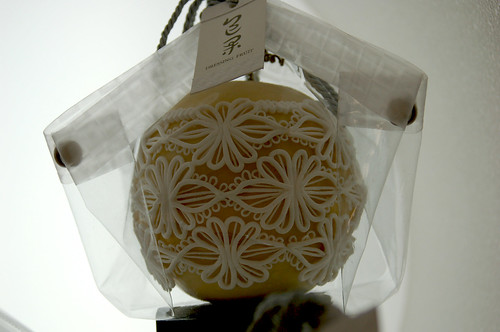
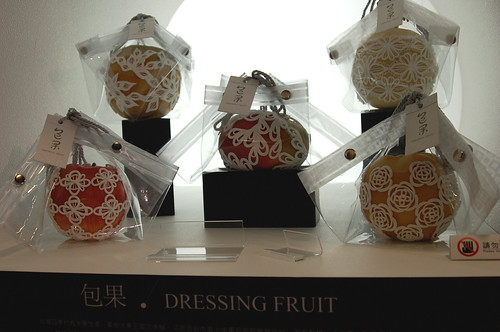
If you’ve ever seen those little green foam protective covers on fruit, then you’d understand this designer’s desire to beautify function. This is one student’s design. Thousands of students participate in YODEX. Around 60 universities from Taiwan and 22 international universities participate in this exhibition occupying two entire exhibition halls at the Taipei World Trade Center adjacent to the landmark Taipei 101 building. I was invited to go by my residency host, Chih Wei, whose alma mater, National Yunlin University of Science and Technology was represented. She explained to me that each student’s work was chosen by jury, and most of the students who were given the opportunity to exhibit were showing what would be considered their thesis work. Some of the work was by non-graduating students, but this is unusual because of the time, resources and funding that goes into it.

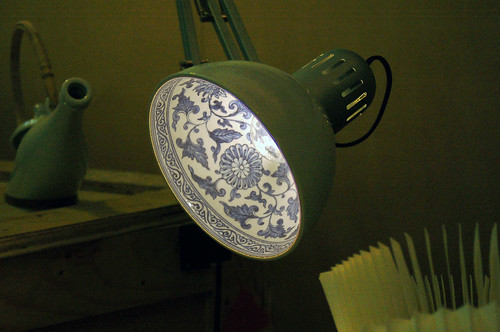 Each University represented a specific department with in their school. By specific, I also mean unique and uber niche; for example, Dayeh University represented their Department of Plastic Art. Other departments included Multimedia and Game Science, Multimedia and Entertainment Science, Digital Content and Animation Design, Techno-Craft Design, Styling and Cosmetology, Technological Product Design, Fashion Imaging; and, of course, Industrial Design, Arts and Design, Visual Communication Design, etc. Within almost every School and Department we toured, we found ceramics! Yea! And, duh. Taiwan has an extremely rich history in that regard, and in the contemporary designs, historical references appeared here and there. Here is Chih Wei standing in front of an elaborate display of various ceramic designs. The light behind her actually looks like Ming Dynasty porcelain inside—a simple, pleasing design idea that actually brings the idea, as opposed to the material, of traditional ceramics into industrial design.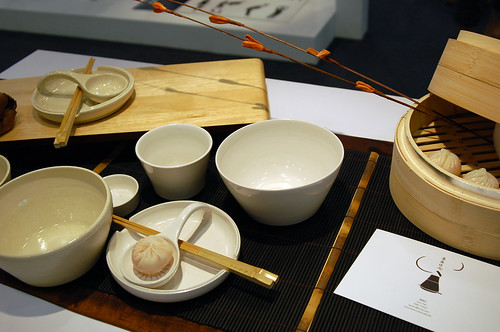
The designers’ products and displays ran the gamut of what can be considered art, design, craft and visual communication in every material imaginable. Some focused on “Green” design, some on the design of new objects, some on packaging design, some on the design of an experience in which objects and images were like supportive props, and some focused on purely conceptual objects. Digital images, animation and computer programming constituted a considerable amount of the exhibition space as well, but since I’m an object maker fascinated by material and its plead for innovation, my attention was swayed by presentations satisfying my interests.

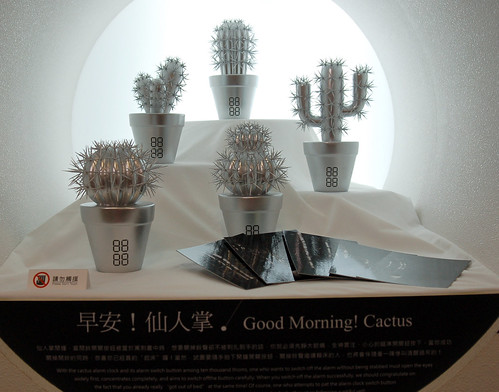
An alarm clock in the form of a potted cactus doesn’t seem all that innovative until it is understood that in order to turn off the alarm, the waking must find the sprig of needles that is the off/snooze button. Not so easy to slip back to sleep after that, eh?

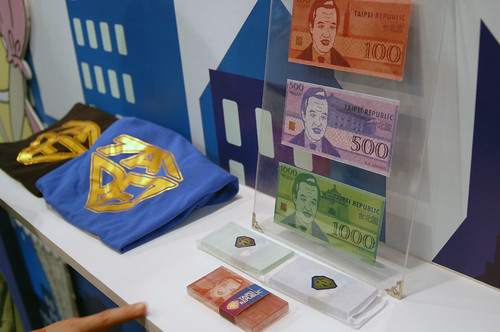 Another popular booth was an entire immigration center for a fictional “Taipei Republic”. Complete with a silly form to fill out and a nonsensical quiz to take before your identification card picture was taken. It was free to receive your I.D. card via e-mail, and a printed souvenir would set you back a nominal sum. I have yet to receive mine, but I haven’t checked the junk mailbox yet. Other souvenirs were for purchase as well such as handmade soap with the image of the President Ma on it, little trading cards and t-shirts reading “Tai-pei” in the shape of . . . what else but . . . the Superman logo. We entered through the “Entrance” gateway looking much like the airport metal detectors, and exited through a similar “Departure” gateway. The whole thing was very entertaining, and politically charged, but Chih Wei and I didn’t discuss the details of how this fabricated republic’s comical immigration experience was viewed in that respect. We were having a good time, and a conversation about politics through translation in the middle of a crowded exhibition hall seemed like it would put a damper on things. There was plenty to be inferred here. Since we both decided to indulge in this designer’s world, I figured nothing too horrible would come of giving out my e-mail address, signing my name and having my picture taken . . . uh . . . well, I guess I can’t take it back now.

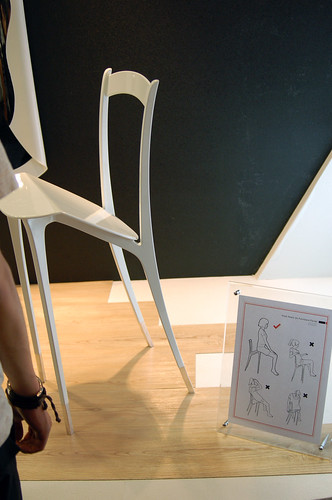
Ok, so, design catering to a unique cultural heritage, and political art sometimes need translation, but touring this exhibition was the opposite of wandering aimlessly in a foreign country. That’s the great thing about art and design, they are their own language, and its one I understand. You do or will too, because good design speaks to elements such as humor, beauty, food and metaphor, of our contemporary lives that are simply human.
Look for the “Good Morning Cactus” and “Dressing Fruit” protectors at stores near you soon.
You can view more pictures of our tour of YODEX on my Flickr page.
Monday, April 26, 2010
MoCA Taiwan: The LaChapelle Show
Surreal is when, as an American on your third day in Asia, you find yourself at a fine art museum watching a Brittany Spears music video, and consequently, the only other blond in the room.
 LaChapelle directed Spears' 2004 video for "Everytime". According to my boyfriend, the video has an altered ending from the original ending of the pop queen's suicidal drowning in her luxury whirlpool. The added ending is Miss Spears waking up from a dream of the suicide, which just ruins the whole thing. And, runs absolutely counter to LaChapelle's tragically glamorous aesthetic. LaChapelle has been the director for a surprising number of pop music videos including Moby, Avril Lavigne, No Doubt, Blink 182, Elton John, Christina Agulera and Mariah Cary, to name a few. Blink 182's "Feeling This" video was popular among the school groups attending the exhibition that day. As the video played on the wall of the stairwell where steps provided stadium seating, the youthful Asian audience giggled at the video's rebelling teens tearing off their school uniforms and busting out of prison-like boarding school joining the band in a punk, mosh-ing, riotous party scene. How cool would that be to go on a school field trip to a museum as a teen and watch music videos? Awesome. However, the rest of the exhibition was an unapologetic display of adult content, and I'm not sure how it works in Taiwan, but if it were the States, every one of those kid's parents would have HAD to sign a consent form.
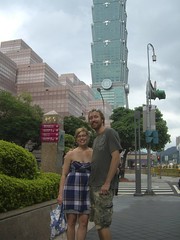
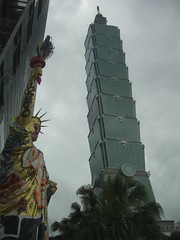
Above: Taipei 101, me and boyfriend, and another surreal moment.
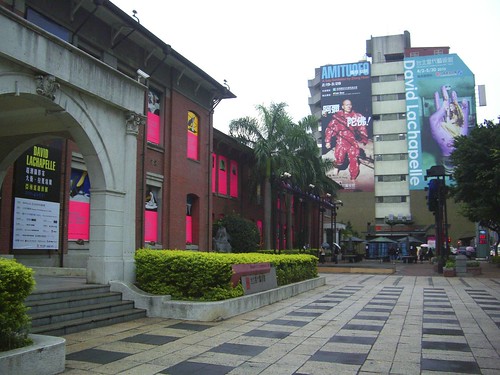
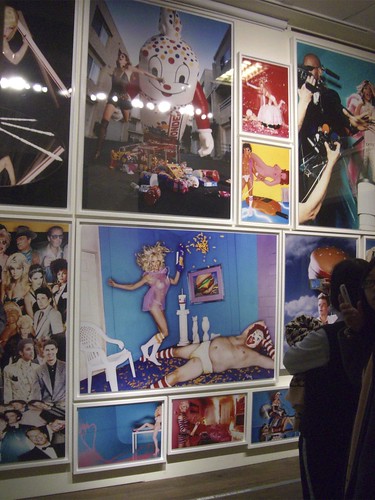
I'm in Taipei, Taiwan awaiting the commencement of my residency at the Yingge Ceramics Museum. I'm here about a week before my first meeting with the residency coordinator and I'm doing the art-tourist thing. First stop: Museum of Contemporary Art, Taipei. The Museum's featured exhibition is a massive display of photographer and filmmaker David LaChapelle's work from 1985 to the present. His first professional gig was for Andy Warhol. The eccentric nature of his work follows suit. The exhibition was sectioned thematically with groupings such as Deluge and Awakened, Holy War, Art in Heaven, and Michael Jackson, the most pointedly descriptive being Excessive Consumption, Celebrity Worship, and 15 Years of American Obsessions. I'm pretty sure Miss Spears fits in that category on all accounts.
LaChapelle directed Spears' 2004 video for "Everytime". According to my boyfriend, the video has an altered ending from the original ending of the pop queen's suicidal drowning in her luxury whirlpool. The added ending is Miss Spears waking up from a dream of the suicide, which just ruins the whole thing. And, runs absolutely counter to LaChapelle's tragically glamorous aesthetic. LaChapelle has been the director for a surprising number of pop music videos including Moby, Avril Lavigne, No Doubt, Blink 182, Elton John, Christina Agulera and Mariah Cary, to name a few. Blink 182's "Feeling This" video was popular among the school groups attending the exhibition that day. As the video played on the wall of the stairwell where steps provided stadium seating, the youthful Asian audience giggled at the video's rebelling teens tearing off their school uniforms and busting out of prison-like boarding school joining the band in a punk, mosh-ing, riotous party scene. How cool would that be to go on a school field trip to a museum as a teen and watch music videos? Awesome. However, the rest of the exhibition was an unapologetic display of adult content, and I'm not sure how it works in Taiwan, but if it were the States, every one of those kid's parents would have HAD to sign a consent form. Each of LaChapelle's works is a vat of religious, art-historical, and pop-culture references. The museum is so packed with this imagery, I'm surprised the windows and doors weren't starting to leek with some kind of chartreuse, syrup-y excrement of all the undigested cultural decadence. A documentary of the staging of the photography showed the workforce, organization and staging involved in The Deluge, a modern re-dux of Michelangelo's Sistine Chapel fresco in c-print. I'm willing to bet that the production of this one print was probably more labor intensive than Miss Spears' faux suicide.
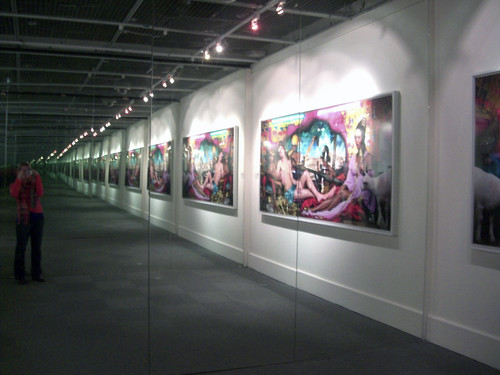
LaChapelle's Rape of Africa, quotes another Renaissance masterpiece, Venus and Mars by Botticelli. This was not my favorite work of the exhibition, but the environment created for its display was the most intriguing. In its own room, the c-print occupied the length of the back wall of the room, but each of the sidewalls to the left and right were floor-to-ceiling mirrors along the entire length of each wall. The imagery of the work is potent enough, but its infinite repetition is absolutely nauseating. Interestingly, the device of the mirror has been appearing in my own art-viewing excursions for the past few years. At the Whitney a few years ago, Rudolf Stingel installed a gold-toned floor for visitors to walk on in one room of his exhibition .... bad day to wear a skirt. The roof of the Metropolitan featured Jeff Koons' mirror-polished stainless steel balloon doggie, reflecting us all as clowns. In Millenium Park, Chicago, Anish Kapoor's "bean" looses its formless form in not only the viewer's reflection, but in reflecting the entire cityscape. I think I'll start some research on the chronology and meaning (maybe . . . do i want to go there?) of what exactly Van Eyck started with The Arnolfini Wedding.
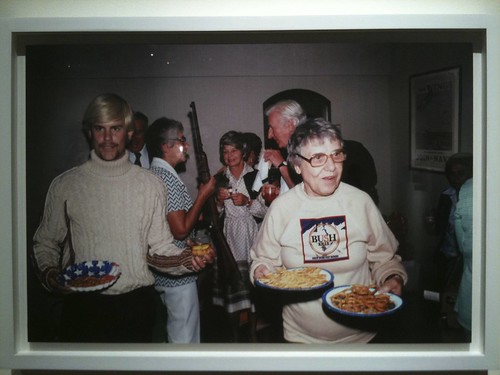
Back to LaChapelle in Taiwan, humor is also a major component of his work. Dark, tragic, morbid, and apocalyptic are all forms of humor that resonate in most of the exhibition, except for a small section of photographs entitled, Recollections in America, where LaChapelle seems to take on a slapstick, political satire role. He has altered vintage photos of America's middle class by adding is own photographic components to create an absurd situation. See if you can tell, left, what is what. After being saturated with images of pop-porno-Hollywood-glamor-glossyness, this was a refreshing end to the LaChapelle Show.
Thank you Mr. LaChapelle, for the visual ephedrine. Unfortunately, now I'm totally crashing, exhausted from jet lag, language barrier, night-market food, three flights of stairs to my miniature studio apartment, and the after-effect of your retrospective. After some much needed sleep, I'm sure I'll be energetic about finally getting to start on my own work. Clay seems so mundane after LaChapelle. I'll take that as a challenge, thank you.
Subscribe to:
Comments (Atom)
